
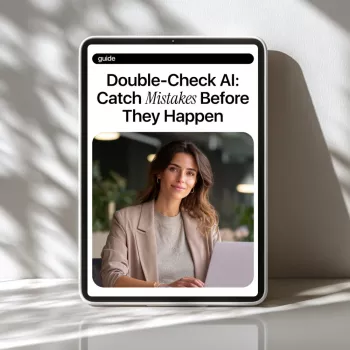
Double-Check AI: Catch Mistakes Before They Happen

AI can save you time, but a confident answer is not always a correct one. A useful summary, recommendation, or calculation still deserves a second look before you rely on it. Our Double-Check AI guide is an affordable option for anyone who wants to be more deliberate about accuracy and trust when using AI.
Why AI Answers Need a Second Look
AI can produce incorrect facts, invented citations, outdated information, or answers that leave out important context. It may also misunderstand your question and give a polished response to a different problem. Fluent writing can make these errors easy to overlook.
A verified answer is different: its important claims have been checked against evidence. That distinction matters especially when a decision involves money, health, legal obligations, or safety. A quick answer can help you identify questions to investigate, but it should not replace current source material or qualified advice.
The NIST AI Risk Management Framework offers a broader perspective on managing AI-related risks. For everyday use, the principle is straightforward: match the depth of your review to the consequences of being wrong.
A Simple Double-Checking Routine
Before checking every sentence, identify what matters most. Ask yourself which claim, number, citation, or assumption would change your decision if it were wrong. Start there, rather than spending equal time on minor wording and consequential details.
- Mark the key claims and assumptions. Separate what the answer states as fact from what it assumes about your situation.
- Find independent evidence. Compare important facts with original documents or trusted primary sources. Check when the source was published or updated and whether it applies to your circumstances.
- Recalculate the numbers. Use the original figures and work through the calculation independently. Make sure the units, time periods, and underlying assumptions match.
- Open the citations. Confirm that each source exists, then read enough of it to see whether it actually supports the claim and its context.
- Get qualified help when needed. For consequential health, legal, financial, or safety decisions, consult an appropriate professional rather than relying on AI alone.
What to Check Before Using an AI Answer
| AI output | Common risk | Practical check |
|---|---|---|
| Factual claim | Outdated or incorrect detail | Compare with a current primary source |
| Citation | Invented or mismatched source | Open the source and check its context |
| Calculation | Arithmetic or assumption error | Recalculate independently |
| Recommendation | Missing personal or situational context | Review assumptions and consult an expert when needed |
For example, if AI summarizes a policy, find the policy itself and check its effective date. If it estimates a monthly cost, verify both the arithmetic and what the estimate includes. A correct calculation based on the wrong price or time period can still lead you astray.
Make AI a Checking Partner, Not the Final Authority
You can ask AI to list the assumptions behind an answer, point out uncertainties, or offer alternative interpretations. You might also ask it to show the steps in a calculation so you can inspect them. These requests can reveal useful questions, even when they do not establish the answer.
A second AI response is not independent proof. It may repeat the first answer’s mistake or rely on similar information. Treat any proposed correction as another claim to verify against an outside source.
Protect your privacy while checking. Avoid sharing sensitive personal or business information, such as account numbers, medical records, confidential plans, or client details. When possible, substitute generic examples or remove identifying details before asking for help.
The NIST Generative AI Profile discusses risks associated with generative AI and can help you consider why oversight matters beyond a single response.
Who May Find Double-Check AI Useful
Our Double-Check AI guide may appeal to everyday AI users who want to build more reliable checking habits. Its focus on accuracy and trust connects to familiar tasks: reviewing a research summary, preparing a workplace draft, or checking an everyday calculation before sharing it.
The guide is listed at $7.99 USD. Visit the Double-Check AI product page for current purchase details.
The same habits can support shopping decisions. If AI suggests an air purifier for your home, for example, verify the specifications and whether they suit your room before deciding. You can review our Advanced HEPA & Activated-Carbon Air Purifier as one option, but an AI recommendation alone cannot establish that any product fits your needs.
Build a Habit That Fits the Risk
Not every answer needs the same level of review. For a low-stakes task, such as polishing a casual message, a quick read for meaning and obvious errors may be enough. For a consequential decision, take more time: trace key claims to their sources, check calculations, and seek professional input where appropriate.
Keep a short checklist of the errors you encounter most often. Yours might include checking dates, opening citations, confirming units, and looking for assumptions about location or eligibility. Update it as your AI use changes. Our team recommends making the routine simple enough to use consistently, while leaving room for deeper review when the stakes rise.
FAQ
Can AI check its own answers?
AI can help identify possible gaps or inconsistencies, but its review is not independent proof. Verify important claims using reliable external sources.
What should I double-check first in an AI response?
Start with the claims, numbers, citations, and assumptions that would have the biggest consequences if wrong.
Is Double-Check AI suitable for everyday AI users?
Double-Check AI focuses on AI accuracy and trust and may appeal to everyday users who want to be more deliberate about checking answers.













Leave a comment