

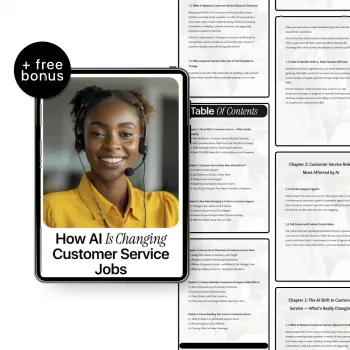
Write Smarter With AI: An Ethical Writing Guide

AI writing tools can help you move from a blank page to a working draft, but useful content still depends on your judgment. You decide what your audience needs, which claims deserve support, and whether the finished piece is fair and clear.
Our eBook Write Smarter With AI offers a practical starting point for creators who want to use these tools more thoughtfully. It brings together guidance on ethical writing, bias awareness, effective instructions, and editing so you can build a review process that fits your work.
Where AI fits in a creator’s workflow
AI can be a helpful assistant at several stages. It can suggest angles when you are developing an idea, arrange scattered notes into a possible structure, or offer alternatives for a sentence that feels awkward. It can also help you identify questions a beginner might ask about a topic.
Those suggestions are starting points, not decisions made for you. An AI-generated outline may overlook an important audience concern, and a polished paragraph can still contain an unsupported claim. You remain responsible for checking the content and deciding what belongs in the final version.
Our Write Smarter With AI eBook focuses on ethical AI writing, bias-aware content creation, effective instructions, and an editing checklist. It is listed at $12.99; visit the product page for current purchase details.
Give clear instructions while leaving room for judgment
A useful request starts with four decisions: who the content is for, what it should help them do, what format you need, and how it should sound. For example, a short introduction for beginners calls for a different approach than a detailed comparison for experienced readers.
Add relevant context, such as the questions your audience commonly asks or the topics you want the draft to cover. Avoid sharing private or sensitive information, including customer details, confidential business plans, or unpublished material you do not have permission to share.
You might ask: “Outline a helpful beginner’s guide to sustainable gardening in a friendly tone. Flag claims that need fact-checking.” The request defines an audience, subject, format, and tone while making room for a later accuracy check.
Review the response before using it. If the outline assumes every reader has a large yard, for example, you might add options for containers or shared spaces. Clear instructions improve the starting point; your knowledge makes it more useful.
Check for bias before content goes live
Bias can appear in obvious stereotypes, but it can also show up in smaller assumptions about income, family structure, ability, or access to resources. Read for statements that treat one group’s experience as universal or describe a group in a way that is inaccurate or excluding.
Look at the examples as a set. Do they reflect a reasonable range of experiences for the audience? Is an important perspective missing? You do not need to represent every possible reader in every paragraph, but you should avoid presenting a narrow example as the only normal choice. When a subject involves a community or experience outside your knowledge, seek relevant perspectives and reliable sources.
Accuracy deserves a separate check. Confident wording is not proof, and AI-generated text can contain errors or invented details. Verify important claims against dependable sources, especially when the subject affects health, finances, safety, or other consequential decisions.
A quick review for AI-assisted drafts
| Review area | Question to ask | Next step |
|---|---|---|
| Accuracy | Can the key claims be verified? | Check reliable sources and correct unsupported statements. |
| Bias | Does the draft rely on stereotypes or sweeping assumptions? | Revise the language and seek relevant perspectives. |
| Voice | Does the content sound appropriate for its audience? | Edit for clarity, tone, and purpose. |
| Privacy | Does the draft expose personal or confidential information? | Remove sensitive details before sharing. |
For broader context, the NIST AI Risk Management Framework addresses the management of AI-related risks, while UNESCO’s Recommendation on the Ethics of Artificial Intelligence provides an international perspective on ethical considerations.
Make the final edit your own
Start your final review with structure. Does the piece answer the reader’s main question early enough? Are related ideas grouped together, and does each section have a clear purpose? Remove repetition before polishing individual sentences.
Next, read for readability and consistency. Replace vague language with specific details you can substantiate, explain unfamiliar terms, and make sure the tone suits the audience. Check that examples, headings, and recommendations support the same central message.
A checklist can help you cover these steps consistently, particularly when you are working on multiple pieces. It cannot decide whether a source is trustworthy or whether a passage treats a community fairly. Give every draft a final human review and take responsibility for what you publish.
Explore our creator resources
If you want a practical framework for responsible AI-assisted writing, Write Smarter With AI brings the key habits together in one eBook. Visit its product page to review current purchase details and decide whether it fits your workflow.
For a different kind of reading, our Quick Beauty Routines Secrets is another eBook you can explore if beauty routines are relevant to your interests.
FAQ
Who is Write Smarter With AI for?
It is an eBook for creators interested in ethical AI writing, bias-aware content creation, effective instructions, and editing.
Can AI-generated content contain bias or errors?
Yes. Review the language for stereotypes and assumptions, and verify factual claims against reliable sources before publication.
Does an editing checklist replace human review?
No. A checklist helps organize your review, but you remain responsible for the final content.
















Leave a comment